
Failure analysis
Failure Analysis is a critical discipline for understanding material failures and identifying the causes of defects, fractures, or structural damage that could compromise the functionality of components and finished products.

ADVANCED FRACTURE, CORROSION, AND COATING ANALYSIS: FAILURE ANALYSIS SOLUTIONS WITH APM IN TURIN
Among the primary techniques used in failure analysis, scanning electron microscopy (SEM) combined with energy-dispersive spectroscopy (EDS) is one of the most powerful methodologies for microscopic and chemical investigation. These advanced techniques are essential for solving complex failure analysis problems, allowing for magnifications of up to 300,000 times to reveal even the smallest structural and compositional defects.
FAILURE ANALYSIS: ADVANCED MATERIAL DEFECT ANALYSIS
The APM laboratory, equipped with a state-of-the-art scanning electron microscope (SEM), performs detailed analyses on samples, not only at the morphological level but also chemically, using the EDS microprobe. This EDS microprobe utilizes X-ray fluorescence to precisely determine the chemical composition of microscopic areas, even those smaller than a micron.
Thanks to this cutting-edge technology, APM can:
✔ Perform scans across the entire sample surface
✔ Generate concentration profiles
✔ Produce detailed element distribution maps
These analyses provide a clear and comprehensive understanding of the composition and potential defects in the examined material.


ADVANCED FAILURE ANALYSIS TECHNIQUES
Investigating the causes of material failure and fractures is essential for predictive maintenance, safety, and process improvement in industrial applications. Failure analysis is widely used across various sectors, employing advanced techniques such as:
FRACTURE SURFACE ANALYSIS
A detailed analysis of fracture surfaces is crucial to determine the failure mode of a material (brittle, ductile, fatigue, etc.). Scanning Electron Microscopy (SEM) allows for an in-depth examination of surface topography and the detection of critical defects such as cracks, inclusions, or porosity that contributed to the failure.
CORROSION STUDY
Corrosion is one of the leading causes of failure in metallic materials, occurring in various forms such as intergranular corrosion, pitting, or crevice corrosion. Electron microscopy and Energy Dispersive Spectroscopy (EDS) facilitate the examination of corrosion products and help determine the specific cause of deterioration, aiding in future damage prevention.
HYDROGEN EMBRITTLEMENT
Hydrogen embrittlement is a phenomenon that compromises the strength of metals, especially steel. SEM analysis helps identify cracks or structural damage caused by hydrogen absorption, improving the understanding of the mechanisms leading to strength and toughness loss.
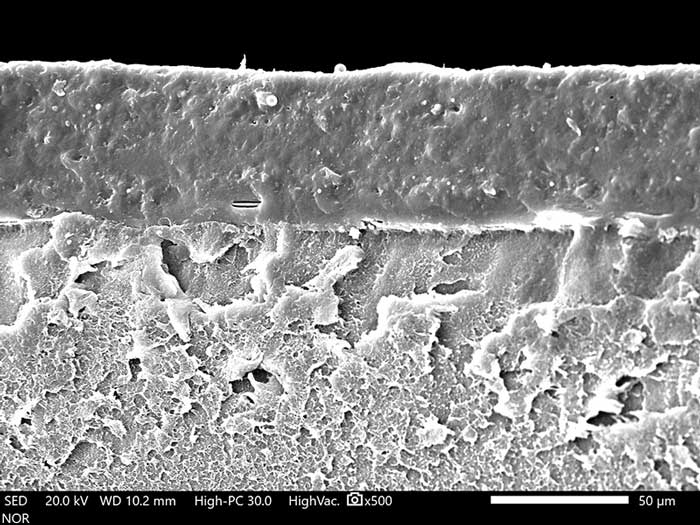
ELECTROPLATED COATING ANALYSIS
Surface coatings such as chrome plating, nickel plating, and galvanization are commonly used to protect metals from corrosion and enhance aesthetics. Failure analysis helps diagnose coating issues such as adhesion defects, internal stresses, or premature wear, which may compromise the material’s protection.
FRACTURE AND BREAKAGE ANALYSIS
Fracture analysis is essential for identifying the root causes of component failure. SEM examination of fracture surfaces provides insight into the fracture mechanism (e.g., fatigue or overload failure) and determines whether the issue stems from design flaws, material defects, or operational conditions.
SEM ANALYSIS OF MANUFACTURING DEFECTS
Defects in manufacturing processes, such as non-metallic inclusions, porosity, residual stresses, or molding defects, can lead to component failure. SEM analysis identifies these defects and assesses their role in material failure, optimizing production processes accordingly.
CHEMICAL ANALYSIS OF ORGANIC RESIDUES
The presence of organic residues on materials or component surfaces can indicate contamination or material degradation. Techniques such as Fourier Transform Infrared Spectroscopy (FTIR) and Gas Chromatography-Mass Spectrometry (GC-MS) are used to detect chemical traces that may have contributed to failure or material degradation.
WELDING ANALYSIS
Welds are often susceptible to defects that can compromise the strength and reliability of a component. Failure analysis of welds, conducted via SEM, helps identify porosity, cracks, or fusion defects that may cause premature failure of the welded joint.




INDUSTRIAL APPLICATIONS AND KEY SECTORS
Failure Analysis is essential in numerous industries, including:
Automotive
Analysis of material defects in vehicles, including metal components and coatings.
AEROSPACE
Investigation of failures in structural materials and critical components, especially those subjected to extreme stress.
PETROCHEMICAL & OIL & GAS
Failure investigation of materials exposed to corrosive environments and high-pressure conditions.
ENERGY SECTOR
Material analysis focused on failure assessment in components of thermal and nuclear power plants.
MANUFACTURING & METALLURGY
Analysis of defects in casting, molding, and heat treatment processes.
Contact Us for More Information
If you are looking for an expert laboratory in fracture analysis, corrosion studies, or electroplated coating evaluation, APM is your ideal choice. We are ready to provide technical support and detailed analyses in compliance with major international standards.
Contact us today for a customized quote!