
Metallography
Metallography is a crucial discipline for ensuring the quality and reliability of materials used in industrial, aerospace, automotive, and many other sectors. The Materials Testing and Analysis Laboratory (APM) in Turin specializes in high-precision metallographic analyses, providing critical data for the development, verification, and diagnostics of metallic materials and their alloys.

METALLOGRAPHY: STRUCTURAL ANALYSIS AND ADVANCED MATERIAL DIAGNOSTICS IN TURIN
The selection of a metallic alloy for a specific application cannot always rely solely on pre-existing data. During the manufacturing process, material properties may undergo modifications that affect performance. For example, changes in grain size, carbide distribution, or the presence of non-metallic inclusions can compromise the strength, durability, and reliability of the material. Therefore, metallographic structural analysis is a crucial step in various industrial sectors, including automotive, aerospace, engineering, and high-precision component manufacturing.
Every stage of the production cycle can influence the structure and properties of metallic materials. Structural defects, improper heat treatments, segregations, and inclusions can affect performance. Advanced metallographic analysis allows for:
- Identifying the material’s microstructure and detecting any non-conformities.
- Determining ferritic and austenitic grain size, essential for assessing mechanical strength and ductility.
- Evaluating the effectiveness of heat treatments and mechanical processing.
- Analyzing casting defects, segregations, and porosity to ensure high-quality products.
- Measuring the thickness and uniformity of galvanic coatings such as chrome plating, nickel plating, and zinc coating.
HEAT TREATMENTS AND MATERIAL CHARACTERIZATION
In addition to microstructure analysis, metallography also includes the evaluation of the effectiveness of heat treatments applied to materials. These treatments are crucial for achieving the desired properties in terms of strength, hardness, and other mechanical characteristics. Surface hardening treatments and galvanic coatings are monitored and analyzed to ensure that the material maintains its optimal performance over time.
REFERENCE STANDARDS
The APM laboratory operates in compliance with major international technical standards, ensuring reliable and consistent results:
- EN ISO 643, ASTM E112: Grain size analysis
- UNI EN ISO 17639: Welding examination
- ASTM E45, UNI 3244: Non-metallic inclusions in steel
- ASTM A892, SEP 1520: Carbide distribution
- ISO 20160: Microstructure of titanium alloys
- ASTM E381: Examination of casting defects and segregations


TECHNIQUES OF METALLOGRAPHIC ANALYSIS
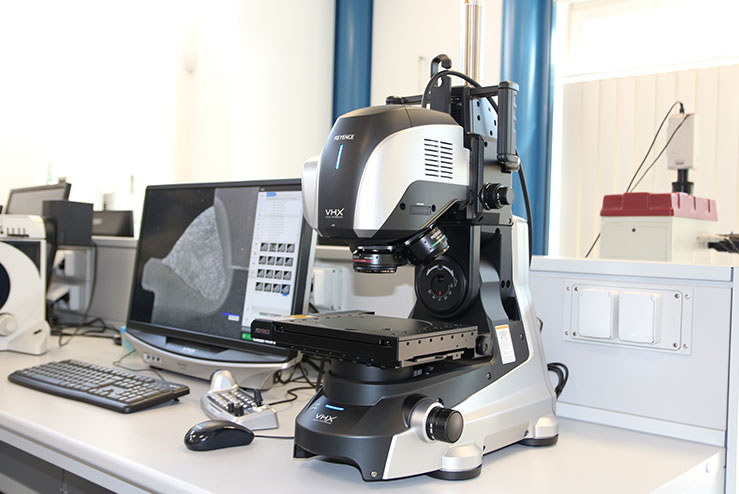
Metallographic analysis utilizes advanced optical and macroscopic microscopy techniques to examine and characterize metallic materials. Chemical etching, polishing, and subsequent optical microscopy observation reveal the internal microstructure and physical properties of the material.
MICROSCOPY
METALLOGRAPHIC STRUCTURE OF FERROUS AND NON-FERROUS ALLOYS
The analysis of metallographic structure allows for the examination of the composition and phase distribution in ferrous and non-ferrous materials, using advanced techniques defined by standards such as EN ISO 643 and ASTM E112.
FERRITIC AND AUSTENITIC GRAIN SIZE
The size of ferritic and austenitic grains is a crucial indicator of a material's mechanical strength. Grain size analysis is performed according to UNI EN ISO 643 and ASTM E112, which provide precise methods for evaluating the microstructure and determining the material’s characteristics.
DECARBURIZATION
Decarburization analysis assesses the loss of carbon from the surface of a material, a phenomenon that can compromise its strength. Decarburization is measured according to UNI EN ISO 3887 and other specific methods.
GRAPHITE DISTRIBUTION IN CAST IRONS
Graphite analysis in cast irons, performed according to UNI EN ISO 945, provides crucial information on the distribution of graphite within the material, which directly impacts the strength and hardness of the cast iron.
NON-METALLIC INCLUSIONS
Non-metallic inclusions, such as oxides and sulfides, can compromise the strength and quality of a material. The examination of non-metallic inclusions is conducted according to ASTM E45, DIN 50602, and UNI 3244, providing critical data to ensure material quality.
CARBIDE DISTRIBUTION
The distribution of carbides in steels, particularly in bearings and other critical components, is analyzed according to ASTM A892, SEP 1520, and ISO 5949 standards. This ensures that the material possesses the appropriate mechanical properties for its intended application.
ALPHA+BETA MICROSTRUCTURE IN TITANIUM ALLOYS
The analysis of microstructure in titanium alloys is essential for determining strength and ductility characteristics. The classification of alpha+beta microstructures is performed according to ISO 20160.
MACROSCOPY
MACROGRAPHIC EXAMINATION OF FRACTURE SURFACES
Macroscopic examination of fracture surfaces allows for the identification of defects and imperfections visible to the naked eye. This examination is essential for determining the cause of mechanical failures, as it provides valuable insights into the nature of the fracture, such as whether it was due to fatigue, overload, or material defects.
EXAMINATION OF CASTING DEFECTS AND SEGREGATIONS
The analysis of casting defects and segregations (according to ASTM E381) is crucial for identifying internal defects that can affect the material's mechanical strength and durability. This examination helps detect issues such as porosity, shrinkage, or non-uniform distribution of alloying elements, which can significantly impact the material’s performance in its intended application.
WELDING EXAMINATION
The analysis of structural defects in welded joints is conducted in accordance with UNI EN ISO 17639, which outlines the guidelines for assessing the reliability of welds and ensuring the quality and safety of joints. This examination is essential for detecting any flaws such as cracks, voids, or incomplete fusion that could compromise the performance and integrity of the welded structure.
FIBER ALIGNMENT IN FORGED PARTS
The analysis of fiber alignment in forged components helps evaluate the quality of the forged material and its resistance to fatigue, in accordance with UNI 3138. This examination is essential for understanding how the fibers are oriented within the material, which significantly impacts the mechanical properties, particularly in terms of strength and durability under cyclic loading.


APPLICATIONS IN DIFFERENT SECTORS
Metallographic analyses are used across a wide range of industries:
Automotive
Inspection of critical components such as axles, gears, and transmission systems.
AEROSPACE
Evaluation of titanium alloys and other high-performance materials.
INDUSTRIAL MANUFACTURING
Inspection of welds and coatings to ensure durability and strength.
RESEARCH AND DEVELOPMENT
Analysis of defects and optimization of manufacturing processes.
Contact Us for More Information
If you need metallographic analysis, galvanic coating measurements, or weld evaluations, trust the APM laboratory in Turin. We are your ideal partner to ensure quality, safety, and performance. Request a quote today!