
MECHANICAL AND TECHNOLOGICAL TESTING
The APM Laboratory in Turin is an excellence center specializing in mechanical and technological testing, offering a comprehensive range of advanced tests to analyze the characteristics and resistance of materials. With state-of-the-art equipment and a highly qualified team, APM Turin is capable of performing hardness, tensile, compression, resilience, and many other material analyses, ensuring precise and reliable results in compliance with international standards.

MECHANICAL AND TECHNOLOGICAL TESTING IN TURIN
Mechanical testing is essential to ensure that materials and components are suitable for use in industrial, automotive, aerospace, and various other sectors. Each test is performed using the most up-to-date techniques and instruments to ensure that the material characteristics meet the required standards. The tests focus on crucial aspects such as hardness, tensile strength, compression, and resilience, enabling the testing and optimization of material performance under different operating conditions.
HARDNESS TESTS: ROCKWELL, BRINELL, VICKERS
Hardness tests are among the most common and useful methods for determining a material’s resistance to deformation. APM Turin conducts hardness tests in accordance with international standards, including:
- Rockwell Hardness (UNI EN ISO 6508-1): This test measures the hardness of materials by the indentation left by a penetrator under a specific load. It is particularly used for metallic materials, such as steels, alloys, and hard materials.
- Brinell Hardness (UNI EN ISO 6506-1): The Brinell method uses a steel or tungsten carbide ball to apply pressure to the material and determine hardness based on the diameter of the indentation left.
- Vickers Hardness (UNI EN ISO 6507-1): This test uses a diamond pyramid penetrator to measure the hardness of materials and is suitable for thin materials and coatings.
These tests are crucial to ensure that materials are suitable for high wear-resistance applications, such as in the automotive, railway, and construction industries.


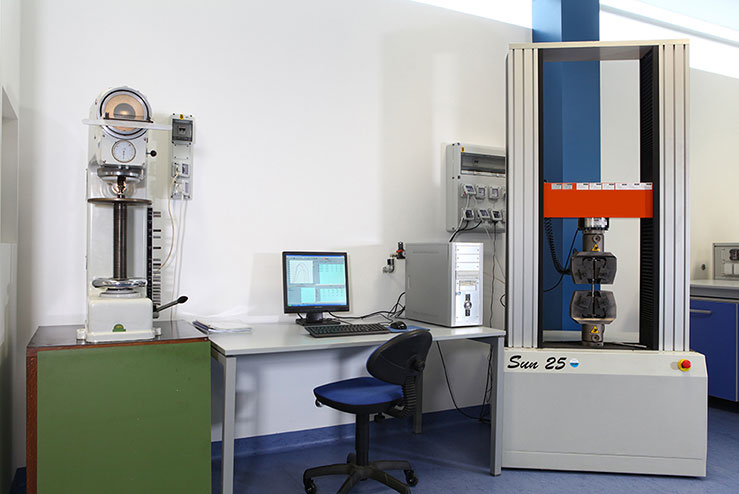
MECHANICAL TESTS
Vickers Microhardness
Microhardness testing is used to analyze hardness at a microscopic level and is particularly important for studying galvanic coatings, welds, and surface treatments. The Vickers microhardness test (UNI EN ISO 14271) is employed to test hardness at specific points, such as welded joints, resistance welds, and metallic coatings. The microhardness of galvanic coatings is crucial to ensure the quality and durability of surface treatments applied to components that must resist corrosion and wear.
Case Depth and Hardening Depth
The depth of hardening and cementation is analyzed using Vickers microhardness (UNI 11153-2) to determine the material's resistance to fatigue and wear after heat treatment. These tests are essential for welded joints, bolts, screws, and other mechanical components subjected to treatments such as cementation, hardening, and nitriding, improving their resistance and lifespan.
Tensile Tests: Welded Joints, Screws, and Bolts
Tensile tests are vital for determining a material's ability to withstand mechanical stress, assessing its capacity to resist pulling forces. APM Turin performs tensile tests on:
- Metallic materials (UNI EN ISO 6892-1): To determine the resistance properties of materials in general.
- Welded joints (UNI EN 876, UNI EN 895, EN ISO 4136): To assess the resistance and integrity of welds under tensile conditions.
- Screws and bolts (UNI EN ISO 898, UNI EN ISO 3506-1): To check the tensile resistance of these fastening elements, crucial in mechanical and automotive industries.
These tests are essential to ensure structural components and assembly parts can withstand tensile forces without sustaining damage that could compromise safety and functionality.
Compression and Extraction Tests
Compression tests are used to determine the material's resistance to deformation under compressive load. These tests are particularly relevant for components that must bear heavy loads, such as those used in construction, the automotive industry, and civil engineering. Additionally, the extraction test is used to test the resistance of metallic components to pull-out stress.
Impact Resistance KV and KCU Tests
Resilience tests (KV, KCU) are critical for evaluating a material's ability to resist impacts and shocks, especially important in extreme environments. APM Turin performs these tests at various temperatures, from ambient conditions down to -196°C, following UNI EN 875 and UNI EN ISO 148-1 standards. This test is useful for materials used under high stress, such as in the automotive, aerospace, and military sectors.
Jominy Hardening Test
The Jominy hardening test (UNI EN ISO 642) is used to determine how a material reacts to quenching. This test is particularly useful for analyzing steels and alloys subjected to heat treatments, helping to understand their ability to form harder, more wear-resistant structures.
Welding Procedure and Welder Qualification Tests
APM Turin is also an accredited center for welding procedure tests (UNI EN 288) and welder qualification. These tests are essential to ensure that welds meet the required quality standards for safety and structural integrity of welded components.


Contact Us for More Information
APM Torino is the ideal partner for all your mechanical and technological material testing needs. Thanks to the wide range of tests available and our experience, we guarantee accurate and reliable results that support the improvement of the quality and performance of your products.
For more information on hardness testing, tensile testing, welder qualification, and other tests, please do not hesitate to contact us and request a personalised consultation. We will be happy to offer you solutions tailored to your specific needs.